

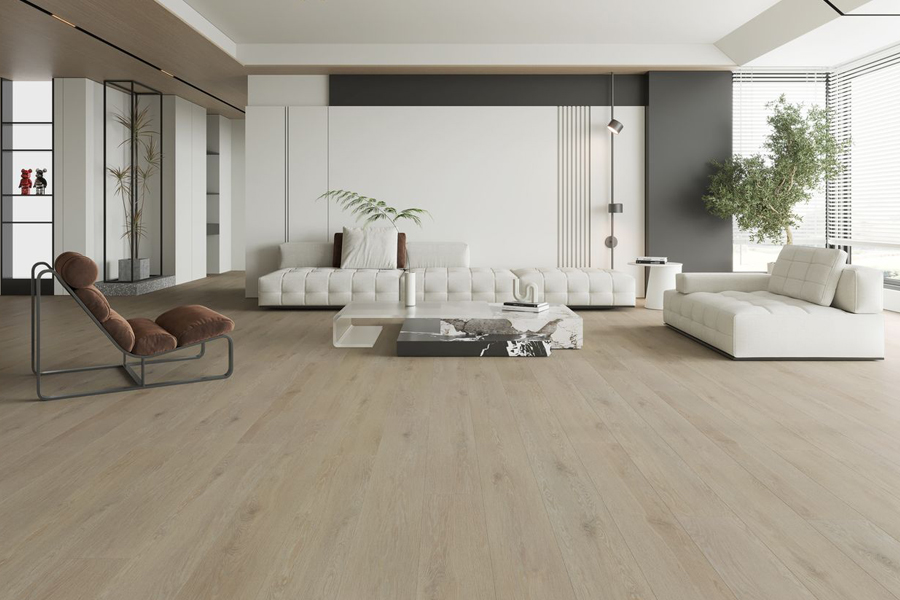
Hardwood and laminate can look nearly identical laid out side by side in a showroom, so the honest way to choose is to stop looking at the sticker price for a minute and ask how each one ages. Hardwood is real wood you can sand and refinish. Laminate is a sharp photograph of wood sealed under a tough clear coat, and you can't refinish it. That single difference drives the cost, the lifespan, and which floor belongs in which room, and it's the thing most spec sheets bury under talk of finishes and click systems.
We sell and install both at our Alexandria showroom, and we fit both in plenty of the same houses, so this is not a pitch for one over the other. It is the comparison we actually walk homeowners through.
What Is Hardwood, and What Is Laminate?
Hardwood is real wood all the way down, while laminate is a four-layer board with no solid wood surface at all. A hardwood floor is either solid wood milled from a single piece, or engineered wood, which is a real-wood top bonded over a plywood-style base for stability. Either way, the surface you walk on and refinish is wood.
Laminate is built up from four layers, and knowing them explains everything the floor can and cannot do. The North American Laminate Flooring Association, the trade group whose certification program the major laminate brands submit to, describes the stack as a clear wear layer on top for scratch and dent resistance, a printed decorative layer that carries the wood or stone image, a core of wood fibers compressed under heat and pressure, and a backing underneath. The wear layer is the clear armor that takes the abuse; the decorative layer is a high-resolution picture. Your eye reads it as oak, but there's no oak in it.
Can You Refinish Hardwood or Laminate?
Hardwood can be refinished and laminate cannot, and this is the difference that outlasts every other one on the list. When a wood floor gets scratched, dull, or dated, you sand off the old finish and the top layer of wood, then stain and seal it fresh. A solid wood floor takes that treatment many times across its life, and a single refinishing pass removes only about 1/32 inch of wood, the figure the National Wood Flooring Association gives in its sand-and-finish guidance. A heavier sanding to lift deep scratches or cupping takes closer to 1/16 inch, so even a floor that has been redone a few times usually has more life left. That's why floors in century-old Alexandria homes are often the original boards, just refinished a handful of times.
Engineered wood can be refinished too, but only if its wood top is thick enough. The National Wood Flooring Association runs a program that certifies which engineered floors can be sanded at all, and it draws the line at a wear layer of 2.5 millimeters on a factory-finished board and 3.2 millimeters on an unfinished one. Below that, there isn't enough real wood above the base to survive the sander. It's worth knowing the number before you buy a thin engineered floor expecting to refinish it later. If your existing wood floors are tired rather than damaged, we cover when to refinish them instead of replacing them in a separate guide.
Laminate doesn't get refinished, because the wood grain is a printed picture and the wear layer above it is thin and clear. Sand a laminate floor and you sand straight through the image to blank fiberboard. When a laminate floor wears out or the surface fails, the fix is a full replacement rather than a refresh. That is the honest trade-off at the center of this whole decision: laminate is cheaper to put down and simpler to live with, and hardwood is the floor you keep bringing back.
Which One Survives a Northern Virginia Winter?
Both survive our climate, but they handle it differently, and the deciding factor is moisture rather than cold. Wood moves with the air around it. The National Wood Flooring Association keeps wood floors happiest between 30 and 50 percent relative humidity and 60 to 80 degrees, and in a long Mid-Atlantic heating season the furnace can pull indoor air well below that range. Dry air shrinks solid boards and can open thin gaps at their edges; humid summers swell them shut again. Narrow seasonal gaps are normal and close on their own. A whole-house humidifier keeps the swing small.
Laminate barely moves with humidity, which is one of its real advantages, but it has a harder limit with standing water. Its core is high-density fiberboard, a dense board of compressed wood fibers that gives laminate its rigidity, and like any wood-fiber product it swells if it stays wet. A wiped-up spill is nothing. A dishwasher leak that sits overnight against a seam is what ruins a laminate floor, from the edges inward. Many newer laminates carry water-resistant surfaces and tighter joints, which buy you time against splashes, though a floor that sees real standing water is a job for tile or luxury vinyl instead. Below grade, where slab moisture rises from underneath, neither solid hardwood nor ordinary laminate belongs without testing the slab first, a point we dig into in our guide to putting laminate over concrete slabs in the DMV.
Hardwood vs. Laminate, Side by Side
What matters | Hardwood | Laminate |
Surface | Real wood, solid or engineered | Printed image under a clear wear layer |
Refinishing | Many times (solid); engineered if wear layer is 2.5 mm or more | Never; replace when worn |
Standing water | Poor; solid wood cups and stains | Poor; fiberboard core swells at seams |
Seasonal humidity | Moves; can gap in dry winters | Stays put |
Durability spec | Janka hardness (red oak 1,290, white oak 1,360) | AC rating (AC3 for most homes) |
Lifespan driver | How many refinishes are left in it | How fast the wear layer wears |
Which Costs Less Over Twenty Years?
Laminate almost always costs less to buy and install, and hardwood often costs less to own, because you refinish it instead of replacing it. The price you pay up front is only the first number. A laminate floor that wears through its clear layer in a busy hallway gets torn out and replaced; a hardwood floor in the same hallway gets sanded and sealed for a fraction of a full replacement and looks new again. Over twenty years in a house that keeps its floors, those two paths separate.
What actually drives the cost on either floor is the grade of the material, the condition of the subfloor underneath, and the labor to prep and install it, which is why the only honest number comes from measuring your rooms. Durability is where the spec sheets earn their keep. On wood, the Janka hardness scale measures the force it takes to press a small steel ball halfway into a board, and the harder the wood the better it shrugs off dents. Red oak, the species American hardness ratings are benchmarked against, sits at 1,290 pounds and white oak a touch harder at 1,360, both plenty for a family home. Harder species climb from there, with hard maple around 1,450 and hickory near 1,820 for a household that wants extra dent resistance. On laminate, the number to read is the AC rating, an abrasion class that runs from AC1 to AC5. AC3 handles an ordinary household, and AC4 or AC5 is the safer pick for a house with big dogs and heavy traffic. That AC scale comes from the European laminate standard, while in North America a laminate earns the ANSI/NALFA LF-01 certification by passing 14 separate categories of testing, so a certified floor has been checked for far more than surface wear.
Common Questions About Choosing Hardwood or Laminate
Is laminate or hardwood better for homes with pets and kids?
For dents and scratches from daily chaos, a high-rated laminate is the more forgiving surface, while hardwood gives you the option to sand the damage away later. A hard-wearing laminate at AC4 or above takes claw marks and dropped toys without showing much, and when it finally looks tired, the whole floor is replaced. Hardwood will show a deep gouge sooner, but that gouge is not permanent the way it is on laminate, since the floor can be refinished. Which trade-off you prefer is the real question.
Can laminate go in a basement or bathroom?
Laminate can go in a basement with the right moisture control, and it doesn't belong in a full bathroom. Its fiberboard core swells with prolonged water, so a room that sees standing water or a wet mop is the wrong home for it. Below grade, a concrete slab has to be moisture-tested before any floating floor goes over it, because slab moisture rises from underneath. For a true wet room, luxury vinyl or tile is the sound choice, and we stock waterproof luxury vinyl for exactly those spaces.
Does hardwood add more resale value than laminate?
Hardwood generally carries more weight with buyers than laminate, because buyers recognize it as a lasting, refinishable surface. Laminate reads as a smart, budget-conscious choice rather than a premium one, which is often exactly right for a rental, a starter home, or a basement. In a home you plan to sell into a market that prizes wood floors, real hardwood is the stronger signal.
How long does each floor last?
A solid hardwood floor can last the life of the house because it can be refinished again and again, while a laminate floor lasts until its wear layer gives out and then gets replaced. The honest way to read those lifespans is that hardwood is renewable and laminate is consumable, and the right one depends on whether you would rather maintain a floor for decades or swap it out when it wears.
Choosing Between Hardwood and Laminate for Your Home
The best choice comes down to how long you want the floor to last, how much water and traffic it will see, and whether you would rather refinish or replace when it wears. Browse the hardwood we carry and the laminate we stock to see the looks side by side, then when you're ready to price it out for your rooms, request a free estimate and we will measure the space, check the subfloor, and talk through which floor fits how you actually live.


