

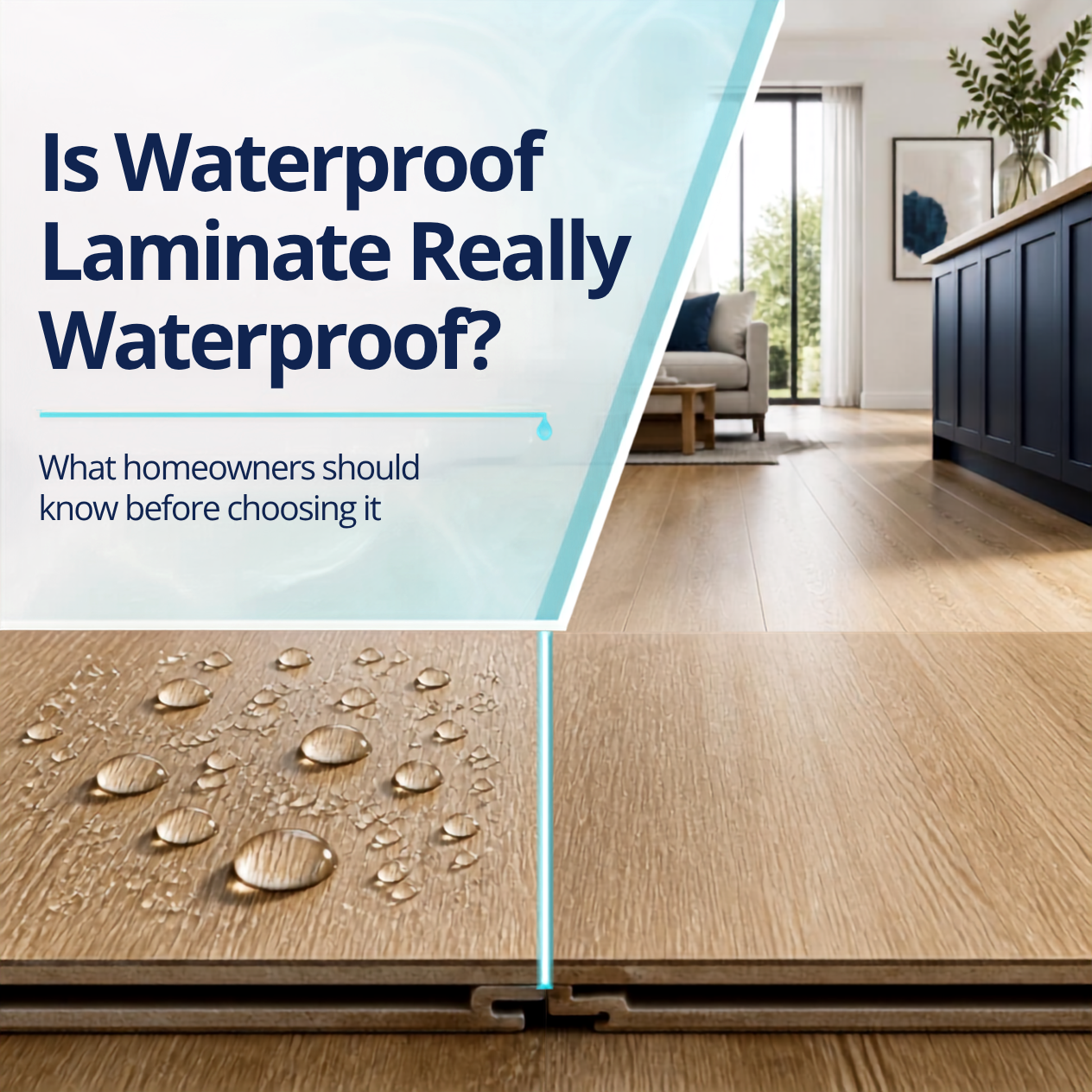
Waterproof laminate resists water on its surface, but its core still swells if water works its way underneath, so the honest answer is that most of it is highly water-resistant rather than truly waterproof. The label sells the surface and hides the weak spot. A laminate floor almost never fails from a spill sitting on top of it; it fails when water reaches the seams and soaks into the board underneath. Knowing where that water gets in tells you which rooms laminate can handle and which ones call for a different floor.
We fit a lot of laminate in Alexandria homes, and we also talk plenty of people out of it for the wrong room. Here's how to tell the difference.
What Does Waterproof Actually Mean on a Laminate Floor?
On a laminate floor, waterproof usually describes the surface and the seams holding out water for a stretch of time rather than a floor you could leave underwater. Laminate is built from four layers: a clear wear layer on top, a printed picture of wood beneath it, a core of compressed wood fiber, and a backing. The top is genuinely tough against spills. It's the core that water ruins. Most waterproof laminate promises that its sealed surface and tighter locking joints keep everyday water out long enough for you to wipe it up, which is a real improvement over older laminate but a weaker promise than a plastic floor that cannot absorb water at all.
The distinction that matters to you is between water-resistant and waterproof. Water-resistant means the floor tolerates spills and damp mopping when you clean up promptly. Waterproof, in the strict sense, means standing water does no damage no matter how long it sits, and very few laminates truly clear that bar because of what they are made of.
Where Water Gets Into a Laminate Floor
Water gets into a laminate floor through the seams between planks and the exposed edges at walls and doorways, then into the core. That core is high-density fiberboard, a dense board of compressed wood fibers that gives laminate its rigidity, and like any wood-fiber product it swells if it stays wet. Once the core takes on water it puffs up at the edges, the planks lift at their joints, and the swelling doesn't go back down when the floor dries. Seams are the weak point. The surface can be flawless while the floor is quietly ruined from underneath.
The vulnerable moments are the ones where water sits: a dishwasher or ice-maker line that weeps overnight, a pet bowl that overflows against a baseboard, a bathroom floor that stays damp after every shower. A cup of water you mop up in a minute is nothing. The same cup left against a seam until morning is what starts the swelling. This is why the surface rating on the box tells only part of the story, and the joint and the edges are where a floor is won or lost.
How Laminate Is Tested for Water
Laminate is tested against a real standard, which is worth knowing when a floor is sold as waterproof. The North American Laminate Flooring Association, the trade group whose certification the major brands submit to, runs a floor through 14 categories of testing to earn its ANSI/NALFA LF-01 certification, and moisture resistance is one of them. A manufacturer can also add a Surface Swell Test on an assembled joint, which locks planks together the way they sit on your floor and measures how that seam holds up to prolonged standing water. That assembled-joint test is the one that speaks to how a real floor behaves, because it tests the seam and not just a sealed plank face. When you shop, a floor certified to LF-01 with the surface swell add-on has been checked where laminate actually fails.
Waterproof Laminate vs. Luxury Vinyl for Wet Rooms
For a room that genuinely gets wet, luxury vinyl beats laminate because its core is plastic and there's nothing in it to swell. Where laminate rides on a fiberboard core, luxury vinyl is built on a rigid or flexible plastic core, so standing water sits on it without soaking in. Its protective top, the wear layer, is measured in mils, or thousandths of an inch, usually 6 to 12 mil in a home and 20 mil and up for commercial floors. That is the floor to reach for in a full bathroom, a laundry room, or a mudroom that takes snowmelt all winter, and we stock waterproof luxury vinyl for exactly those rooms.
Room | Water-resistant laminate | Luxury vinyl |
Living room, bedroom | Good fit | Good fit |
Kitchen | Fine with prompt cleanup | Better against leaks |
Full bathroom | Not recommended | Recommended |
Laundry, mudroom | Risky | Recommended |
Basement | Only with slab moisture control | Good with slab moisture control |
Which Rooms Can Take Water-Resistant Laminate?
Water-resistant laminate is a sound choice for living rooms, bedrooms, hallways, and kitchens where spills get wiped up, and a poor choice for full bathrooms and laundry rooms. A kitchen is the classic in-between: a good water-resistant laminate handles the daily splashes fine, and its weak point is a slow appliance leak, so it pays to choose a floor rated AC4 on the abrasion-class scale that runs AC1 to AC5, a scale that comes from the European laminate standard EN 13329, and to keep an eye on the dishwasher. Bathrooms and laundry rooms see too much standing water for the core to survive long term. A fiberboard core is a wood-fiber product, and like solid wood it does best when indoor humidity stays in the 30 to 50 percent range the National Wood Flooring Association publishes, so a room that runs humid after every shower works against it even with no spill.
Basements are their own question, because the water threat comes from below. A concrete slab holds moisture that rises into whatever sits on it, so before any floating floor goes down, the slab should be moisture-tested, most reliably with the relative humidity probe test known as ASTM F2170 or the older calcium chloride test, ASTM F1869. A quick surface reading follows its own standard, ASTM F2659, though the probe test is the one to trust. We walk through the slab-and-vapor details in our guide to laminate over concrete slabs in the DMV. Skip the moisture test and a basement laminate can swell from underneath even without a spill in sight.
Questions About Waterproof Laminate
Can waterproof laminate go in a bathroom?
Waterproof laminate is not the right choice for a full bathroom, and it can work in a half bath with care. A powder room with only a sink sees little standing water, so a water-resistant laminate can hold up there. A full bath with a tub or shower puts too much water and humidity against the seams over time, and luxury vinyl or tile is the durable answer.
What happens if water gets under laminate?
Water that reaches the fiberboard core makes it swell, and that swelling is permanent. The planks lift and separate at the seams, and because the core does not shrink back when it dries, the fix is replacing the affected boards rather than drying them out. Catching a leak fast is the whole game.
Is waterproof laminate the same as water-resistant laminate?
Waterproof and water-resistant laminate get marketed as the same thing, and the real gap between them is how long the floor can sit wet. Water-resistant laminate handles spills you clean up; waterproof laminate adds a sealed or upgraded core and tighter joints to buy more time against standing water. Neither is a license to let water pool, and the safest habit is to treat any laminate as water-resistant and act accordingly.
How is waterproof laminate warranted?
Waterproof laminate is typically warranted against surface water for a stated period, with conditions that spills be wiped up and that the floor not be flooded or wet-mopped. The exact terms differ by product and change over time, so read the warranty on the floor you're actually buying before you count on it. A warranty that covers topical water is a weaker promise than one that covers a standing leak.
Getting the Right Floor for a Room That Sees Water
The right call comes down to how much water a room really sees and how long it sits: water-resistant laminate for living spaces and careful kitchens, luxury vinyl or tile for bathrooms, laundries, and wet basements. Browse the laminate we carry and read the basics on our laminate information page, and when you want a straight answer for a specific room, request a free estimate and we'll look at the space, check the subfloor, and steer you to a floor that won't let you down.


