

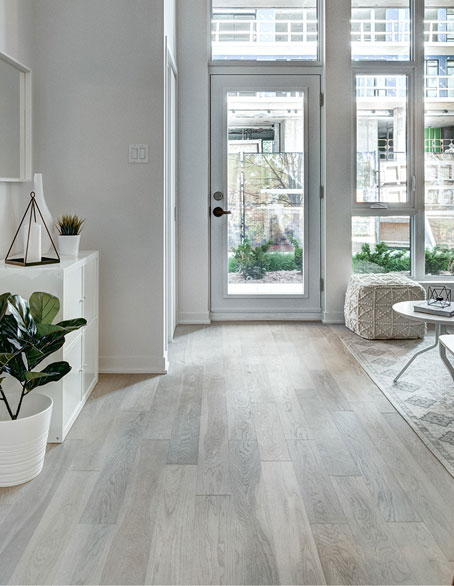
Two numbers decide most laminate purchases, and buyers routinely read the wrong one. The AC rating tells you how well the surface resists wearing through, and it's the number that matters for durability. Thickness tells you how solid the floor feels and sounds and how well it hides a slightly uneven subfloor, and a thicker plank is not automatically a tougher one. Get those two straight and you'll pick a laminate that holds up in the room you're putting it in without paying for a spec you don't need.
We sell laminate across grades at our Alexandria showroom, so we field these questions every week. Here's what each number really means.
What Is an AC Rating on Laminate?
An AC rating is an abrasion class that measures how well a laminate's surface resists wearing through, and it runs from AC1 up to AC5. The letters stand for Abrasion Class, and the higher the number, the more traffic the floor takes before the printed wood-look layer wears out. AC3 covers an ordinary household. AC4 steps up to heavy home traffic and light-commercial use, and AC5 is built for genuine commercial floors like shops and offices. The rating speaks only to surface wear, so it's the spec to weigh against how hard your family is on a floor.
The number is not a marketing guess. It comes from a Taber abrasion test, where weighted wheels wrapped in sandpaper-like grit spin against the surface until the decor layer wears through, and the number of rotations the floor survives sets its AC class. A floor earns AC4 by outlasting an AC3 floor on that machine. Knowing the test exists is what lets you trust the number over a salesperson's adjectives.
What AC Rating Do You Actually Need?
The AC rating most homes need is AC3, and a busy household should step up to AC4. AC3 handles bedrooms, living rooms, and ordinary hallways without trouble. AC4 is the smarter pick for a kitchen, an entry, or any home with big dogs, kids, and heavy daily traffic, because the extra abrasion resistance shows up exactly where floors wear fastest. AC5 is more floor than a house needs, built for commercial traffic, though it does no harm beyond costing more. Matching the rating to the room is how you avoid both a floor that wears out early and one you overpaid for.
Does Thicker Laminate Mean a Tougher Floor?
A thicker laminate is not a tougher floor, and this is the single most common mistake buyers make at the sample rack. Thickness is the height of the whole plank, sold in a range from about 6 or 7 millimeters up to 12 millimeters, and it controls three things: how solid the floor feels underfoot, how quiet it sounds, and how well it bridges small dips and high spots in the subfloor. A thin 6 or 7 millimeter plank flexes down into subfloor imperfections and can leave visible high edges, while a 10 or 12 millimeter plank is stiff enough to ride over them. What thickness does not do is make the surface resist scratches.
Surface toughness lives in the wear layer, the clear coat on top that the Flooring Institute calls the single most important durability spec on a floor. A thick plank with a low AC rating scratches just as easily as a thin one, because the sander in that Taber test never reaches the core. So a 12 millimeter AC3 floor feels wonderful and wears like an ordinary floor, while an 8 millimeter AC5 floor feels a little hollow and outlasts it. If you want the solid feel without paying for thickness, a good underlayment, the thin cushioning layer rolled out under the planks, improves the sound and feel of any thickness for less than stepping up a tier. The wrong underlayment can telegraph subfloor flaws, so it's worth matching to the floor.
AC Rating and Thickness at a Glance
Spec | What it measures | What it does not do | What to pick |
AC rating | Surface wear resistance | Say anything about feel or sound | AC3 for most rooms, AC4 for kitchens and busy homes |
Thickness | Feel, sound, subfloor bridging | Make the surface tougher | 10 to 12 mm for a solid feel, thinner is fine over a flat subfloor |
Wear layer | Where durability actually lives | Show on the box as a single number | Read it through the AC rating |
AC Ratings vs. the NALFA Certification
The AC rating and the certification stamp on a laminate are two different marks, and knowing the difference tells you how much a floor has really been tested. The AC scale comes from the European laminate standard EN 13329, and it has become the common shorthand for durability in showrooms here. In North America, a laminate earns the ANSI/NALFA LF-01 certification from the North American Laminate Flooring Association, the trade group whose program the major brands submit to, by passing 14 separate categories of testing, from moisture and impact to stain resistance and color fastness. Abrasion is only one of those 14. A floor that carries both a solid AC rating and the LF-01 certification has been checked far more thoroughly than one showing an AC number alone, and the core under the surface is high-density fiberboard, a dense wood-fiber board that gives the plank its rigidity but swells if it stays wet.
Questions About Laminate AC Ratings and Thickness
Is AC4 laminate worth it over AC3?
AC4 is worth the step up for kitchens, entries, and homes with pets or heavy traffic, and AC3 is plenty everywhere else. The extra abrasion resistance earns its keep in the rooms that wear fastest. In a guest bedroom or a formal living room that sees light use, paying for AC4 buys durability you'll never use up.
Is thicker laminate always better?
Thicker laminate feels more solid and sounds quieter, but it is not more durable, so better depends on what you're after. If your subfloor is flat and you mainly want wear resistance, a thinner plank with a high AC rating outperforms a thick one with a low rating. If you want the underfoot feel of hardwood or need to ride over a slightly uneven subfloor, thickness is where to spend.
What AC rating is best for a kitchen?
AC4 is the sound choice for a kitchen, because kitchens combine heavy foot traffic with dropped pans and pulled-out chairs. AC3 will survive a low-use kitchen, but AC4 gives you margin in the busiest room in most houses. Pair it with prompt cleanup of spills, since laminate's fiberboard core is still vulnerable to standing water regardless of the rating.
Does the AC rating cover water resistance?
No, the AC rating measures only surface abrasion and says nothing about water resistance, and the two are easy to confuse. A high AC number tells you the floor resists scratching and wear, and it reveals nothing about how the floor handles a leak. Water resistance is a separate feature of the core and the seams, and it is worth checking on its own if the room ever gets wet.
Matching a Laminate to How Your Home Lives
The right laminate pairs an AC rating to your traffic and a thickness to your subfloor and your ears, and once you read the two numbers separately the choice gets simple. Browse the laminate we carry, read more on our laminate information page, and if you want a hand matching the specs to your rooms and checking whether your subfloor needs work first, our team handles flooring installation across the area. When you're ready to price it out, request a free estimate and we'll measure the space and talk through the options.


