

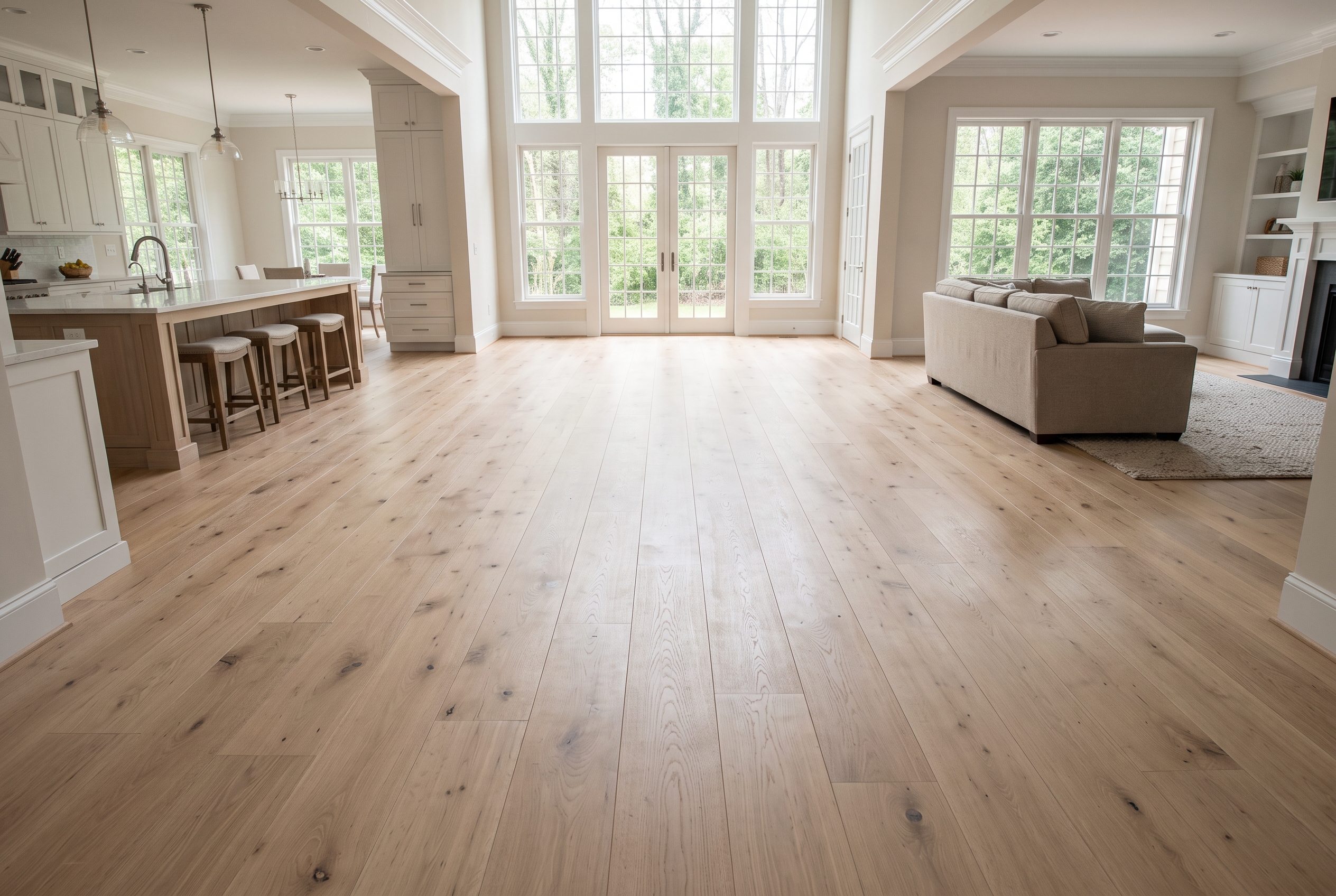
A board 5 to 7 inches wide gives most rooms the wide-plank look without asking much of the house. Past about 7 inches, choose engineered boards, a flat subfloor and steady indoor air through our dry winters and damp summers. That's because a wide board shrinks and swells across its face far more than the 2 1/4-inch oak strip in older homes here, and everything about a wide floor follows from it.
| Width | Where it works | Construction | What it asks of the house |
|---|---|---|---|
| 3 to 5 inches | Small rooms, halls, next to old strip | Solid or engineered | Ordinary care |
| 5 to 7 inches | Most rooms and open plans | Either; engineered is easier | Humidity held in range |
| 7 to 9 inches | Large rooms, long sightlines | Engineered | Steady humidity, flat subfloor, glue |
| Over 9 inches | Big open plans, a statement floor | Engineered | Tight humidity control and careful installation |
What Counts as Wide Plank Flooring?
Wide plank flooring is anything wider than 5 inches. The National Wood Flooring Association (NWFA) classes boards under 3 inches as strip, boards of 3 to 5 inches as plank, and anything wider as wide plank. In everyday use, 7 inches and up often gets called extra-wide.
The 2 1/4-inch oak strip in so many Alexandria and Arlington houses is the classic strip floor. Wide planks show more of each board's grain and put fewer seams across a room, and that calm, open look is most of their appeal.
The width on a carton is the board's nominal size, and the face you see once the tongue is locked in can measure a little less. Some of the oldest houses here go the other way, with Old Town's original floors of heart pine and other old-growth wood in boards far wider than anything sold as standard today.
Why Wide Boards Move More Than Narrow Ones
Wood swells and shrinks across its width as the moisture in the air changes, and the amount grows with the board's width. A 7-inch board moves about three times as much as a 2 1/4-inch strip of the same wood. It's about three times as wide, and that's the whole reason.
The USDA's Forest Products Laboratory gives the numbers. Flat-sawn red oak changes width by about 0.0037 of its width for every point of moisture it gains or loses. Flooring leaves the mill at 6 to 9 percent moisture. Red oak settles near 6 percent in air at 30 percent humidity.
Say the boards dry from 9 percent in August to 6 percent in February. Here's what each width gives up:
| Red oak board width | Width lost, 9 to 6 percent moisture |
|---|---|
| 2 1/4 inches | Under 1/32 inch |
| 5 inches | Just under 1/16 inch |
| 7 inches | About 5/64 inch |
| 9 inches | About 3/32 inch |
Across a whole room, the total movement is about the same whatever the width, since the room holds the same amount of wood. What changes is where it shows. Narrow strip spreads it across many hairline gaps you'd barely notice. Wide planks gather it into fewer, wider gaps, and they cup more readily, because each board has more width to bend across.
Species and cut change the numbers. Hickory moves a little more than red oak, at about 0.0041 per point, and hard maple a little less, at about 0.0035. Quartersawn and rift-sawn boards, cut so the growth rings run up and down through the board, move noticeably less across their width than flat-sawn ones, which makes them a steady choice for a wide floor.
Cupping, Crowning and Gaps in a Wide Plank Floor
In a wide plank floor, the shape of the boards tells you where the moisture is. Gaps between boards mean the wood has dried, usually in the heating season. Cupping, with the edges higher than the centers, means the underside is wetter than the top. Crowning, with the centers higher than the edges, usually means a cupped floor was sanded flat before it dried.
Gaps are the most common shape, and they're the least worrying. Seasonal gaps are normal in any wood floor, and wide boards that open in February and close by June are simply behaving like wood. Gaps that stay open through a humid summer point to boards installed too wet or a house that's too dry all year, and they're worth a humidity check before anything else.
Cupping comes from moisture underneath: a humid stretch in a house without air conditioning, a damp crawlspace or basement, a slab, or a leak. Find and fix the source first. Many cupped floors flatten on their own once the moisture evens out, which can take weeks or a season.
Crowning usually comes from a sanding rather than the weather. If a cupped floor is sanded flat while the boards are still wetter underneath, the raised edges get cut away. When the wood dries, the centers stand proud of the edges. Moisture readings at the top and bottom of the boards, taken before any sanding, prevent it.
Boards that cupped from a one-time leak and dried flat can usually be sanded and refinished. Boards damaged by long-standing moisture may need replacing, and the subfloor underneath needs checking at the same time.
Which Construction Holds Up Best at 7 Inches and Wider
Engineered is the safer construction for boards 7 inches and wider, because its core of cross-layered plies resists the swelling and shrinking a wide solid board wants to do. The top layer is real wood and still moves a little, but the core holds it in check, so an engineered wide plank cups and gaps less than a solid board of the same width.
Solid wide boards can work, and plenty of old houses prove it. They ask more of the house, though, starting with humidity held steady all year, a flat wood subfloor, careful moisture matching at installation, and adhesive as well as nails. If you want solid at width, quartersawn or rift-sawn boards are the steadier way to get there.
Engineered also goes where solid can't. It can be installed below grade and over a dry concrete slab, glued down or floated as its maker allows, so it's the natural choice for a basement or the slab level of a split-level house. A slab gets a moisture test before any wood floor is glued or floated over it, because moisture rising through concrete is what cups a floor laid on it.
When you compare wide engineered boards, check the spec sheet for overall thickness, which makes a board feel more solid underfoot, and for the wear layer, which decides whether it can be sanded someday. Look at the lengths too, since longer boards keep a wide floor from looking choppy.
Mannington's Handcrafted collection, a 7-inch engineered plank in lengths up to 84 inches, is one of the wide lines in our engineered hardwood.
Choosing a Width for Your Room
Match the board to the size of the room and to the floors it meets. A board that looks generous in a 20-foot great room can crowd a 9-foot hallway, and one that suits a hallway can look busy across an open main floor.
Small Rooms and Hallways
Boards of 3 to 5 inches suit rooms under about 12 by 12 feet and narrow halls. A very wide board leaves only a few full boards across a small room, and the cut board at the wall gets noticeable. Run hallway boards down the length of the hall, which makes it read longer.
A long, narrow room with little furniture can still carry a wide board if the layout is planned so neither wall ends in a sliver. Measure the room across the boards before you choose, and divide by the board's face width to see how wide the last row will come out.
Open Main Floors and Large Rooms
Boards of 6 to 9 inches suit large rooms and open plans, where long sightlines let a wide board read as calm instead of busy. Run them along the longest sightline or toward the main windows, and choose long lengths to go with the width, since short wide boards make a choppy floor.
Mixed-width layouts, with two or three widths laid in a repeating pattern, give a big room the look of an old floor. An open plan is also where engineered earns its place. One continuous floor across a kitchen, dining room and living room has no doorways to break up its movement, so the steadier board pays off across the whole run.
Next to an Existing Narrow Oak Floor
Where new wide boards meet an existing narrow oak floor, as they often do upstairs and on the stairs in colonials here, make the change at a doorway with a threshold, or carry the old 2 1/4-inch width into the new room. Species and stain matter more than width. A wide white oak plank finished close to the old oak reads as a deliberate step up, while a near-match in a different species reads as a mistake.
If the original floor is due for a refinish anyway, the two can be brought to the same color. Matching existing floors to a new one is part of our hardwood refinishing work, as closely as the old wood allows.
How Wide Plank Hardwood Should Be Installed
Wide boards go down over a flat, dry subfloor, with the wood and the subfloor close in moisture before work starts. They're fastened tight and given room to move at the edges, and each of these steps matters more at 7 inches than at 2 1/4:
- Check moisture first. The NWFA asks for plank flooring and its subfloor to be within 2 percent moisture content of each other, against 4 percent for narrow strip, and a moisture meter on both shows where they stand.
- Run the heat or air at normal settings before and during the job, so the wood meets the house at the moisture it will live at.
- Flatten the subfloor. A wide board can't follow a dip the way a narrow one can, so high spots get sanded and low spots filled before the first row.
- Fasten for the width. Solid plank is blind-nailed through the tongue every 6 to 8 inches and within a few inches of each end, and on wide boards a bead of adhesive alongside the nails keeps them from moving and squeaking. Engineered planks are stapled, glued or floated as their maker allows.
- Stagger the end joints farther apart than on strip. On planks wider than 5 inches, a common rule is to keep end joints at least a board's width apart.
- Leave expansion space at every wall, hidden under the baseboard.
- Over a crawlspace, cover the soil with a vapor barrier. Over a slab or below grade, the floor is engineered, glued down or floated.
Adhesive doesn't make a wide floor immune to moisture. It holds the boards down so they move less and stay quiet, and the humidity routine does the rest.
Keeping Wide Planks Flat Through a Northern Virginia Year
Wide planks stay flat when the air in the house stays steady, between 30 and 50 percent relative humidity at 60 to 80 degrees, the range the NWFA gives for wood floors. Mannington sets a tighter floor for its engineered hardwood, asking that humidity never drop below 35 percent, so follow the maker's number for the floor you own.
Our heating season is where wide floors get tested. From about December into March, a furnace can pull indoor humidity well below 30 percent, and that's when wide boards open their biggest gaps. Summer pushes the other way, and a house without air conditioning through a muggy August week can see boards swell and edges lift.
- Put a hygrometer in the main room and check it every week in winter and summer.
- Run a humidifier through the heating season, a whole-house unit on the furnace or room units, to keep readings in range.
- Run the air conditioning or a dehumidifier through humid stretches to keep readings under 50 percent.
- Keep crawlspaces and basements dry, with a vapor barrier on the soil and a dehumidifier where it's needed.
- Fix gutters and grading that send water toward the foundation, since water under the house ends up in the floor.
Species, Grade and Texture at Wide Widths
Oak, red or white, is the most common choice for wide boards, and white oak is the look that leads floor colors right now. Of the common species, hickory moves the most and shows it at width, though its wild color hides scratches well. Hard maple moves a little less than oak, but its pale, smooth face shows every gap more plainly. Picking from the species that handle our climate well makes the humidity routine easier, though no species is exempt from it.
Character grades, with knots, color variation and mineral streaks, suit wide boards, because a broad face shows a whole slice of the tree and knots look at home on it. Clear grades with little variation give a calm, formal floor, and on a wide board they make each seam and gap stand out more.
Wire-brushed and hand-scraped textures hide the scratches that pets and grit leave far better than a smooth face. On a wide board, where a scratch runs across more of what you see, that's worth having in a busy house, and a matte or satin sheen helps for the same reason. Oak, hickory, maple, walnut and pine are all in our hardwood catalog.
What Wide Plank Hardwood Costs
Nationally, hardwood runs about $6 to $25 a square foot installed, in HomeAdvisor's cost figures, and wide planks sit toward the upper part of that range. Material alone runs about $4.50 to $16 a square foot for engineered and $5 to $28 for solid, and labor about $3 to $6 a square foot.
| 500-square-foot open plan | Per square foot | For 500 square feet |
|---|---|---|
| Engineered, material | $4.50 to $16 | $2,250 to $8,000 |
| Solid, material | $5 to $28 | $2,500 to $14,000 |
| Labor | $3 to $6 | $1,500 to $3,000 |
| Installed, all in | $6 to $25 | $3,000 to $12,500 |
Width costs more for a simple reason: a wide board has to come from a bigger log, and milling it wastes more of that log. Species, grade and wear-layer thickness move the price as much as width does. Quartersawn boards cost more than flat-sawn because the cut yields fewer boards from each log.
The rest of a quote is the work around the boards. Taking up an old floor adds about $2 to $4 a square foot, and subfloor repairs run about $900 to $3,000 when they're needed. Adhesive alongside the nails adds material and time on a wide solid floor.
We price the room once we've seen the subfloor, because flattening it is the line that changes most from house to house.
Wide Plank Hardwood at Rick's
At Rick's Flooring, we carry wide engineered hardwood from Mannington and from Mohawk's TecWood line, along with solid hardwood from Bruce and Somerset for rooms where a narrower solid board fits better. Any style can be sampled, or dropped into a photo of your own room, before you decide on a width.
Our installation crews put down the hardwood we sell, and subfloor repair is part of that work when a floor needs flattening first. Book a free in-home estimate and a project specialist will come out, measure the rooms and price the boards you're considering.
Our crews install wide plank floors from Arlington and Springfield to Maryland and Washington, D.C., working out of our Alexandria showroom on Richmond Highway.
Questions About Wide Plank Floors
Do Wide Planks Make a Room Look Bigger?
Yes, in an open room, where fewer seams read as calm and the floor can feel larger. In a narrow room or hallway, very wide boards leave only a few full boards across the floor and a cut board at each wall, which can make the space feel tighter.
Direction does as much as width. Boards that run along a room's longest dimension stretch it, and boards run across a narrow room make it feel wider but shorter.
Can Wide Plank Hardwood Go in a Kitchen?
Yes, and engineered is the safer choice there, since a kitchen sees water at the sink and dishwasher. A breathable mat at the sink, quick work on spills and an occasional check of the dishwasher's connections keep wide boards flat.
Solid wide boards can go in a kitchen too, with steady humidity and no standing water, but a leak shows on them sooner.
Can Wide Plank Floors Be Refinished?
Yes. Solid wide boards sand like any solid floor, and the NWFA says most solid floors can be sanded six to eight times over their life. An engineered wide plank can be refinished if its wear layer is thick enough, which for a factory-finished board means at least about 2.5 millimeters.
A wide floor that has cupped gets refinished only after it has dried flat, or the sanding leaves it crowned.
Can Wide Plank Hardwood Go Over Radiant Heat?
Yes, with engineered boards approved for it. Mannington allows most of its engineered styles over hydronic radiant heat as long as the floor's surface stays at 85 degrees or less, and it asks that a new system be run hard first to drive moisture out of its concrete topping.
Solid wide boards are the riskiest choice over radiant heat, since the heat dries them more than any other spot in the house, and wide boards show that drying as gaps.
Planning a Wide Plank Floor With Us
Bring the room's size, the floors it meets and what's under it to an estimate visit, where one of our project specialists will measure the rooms and price a wide plank floor in the width and construction that suit your house.


