

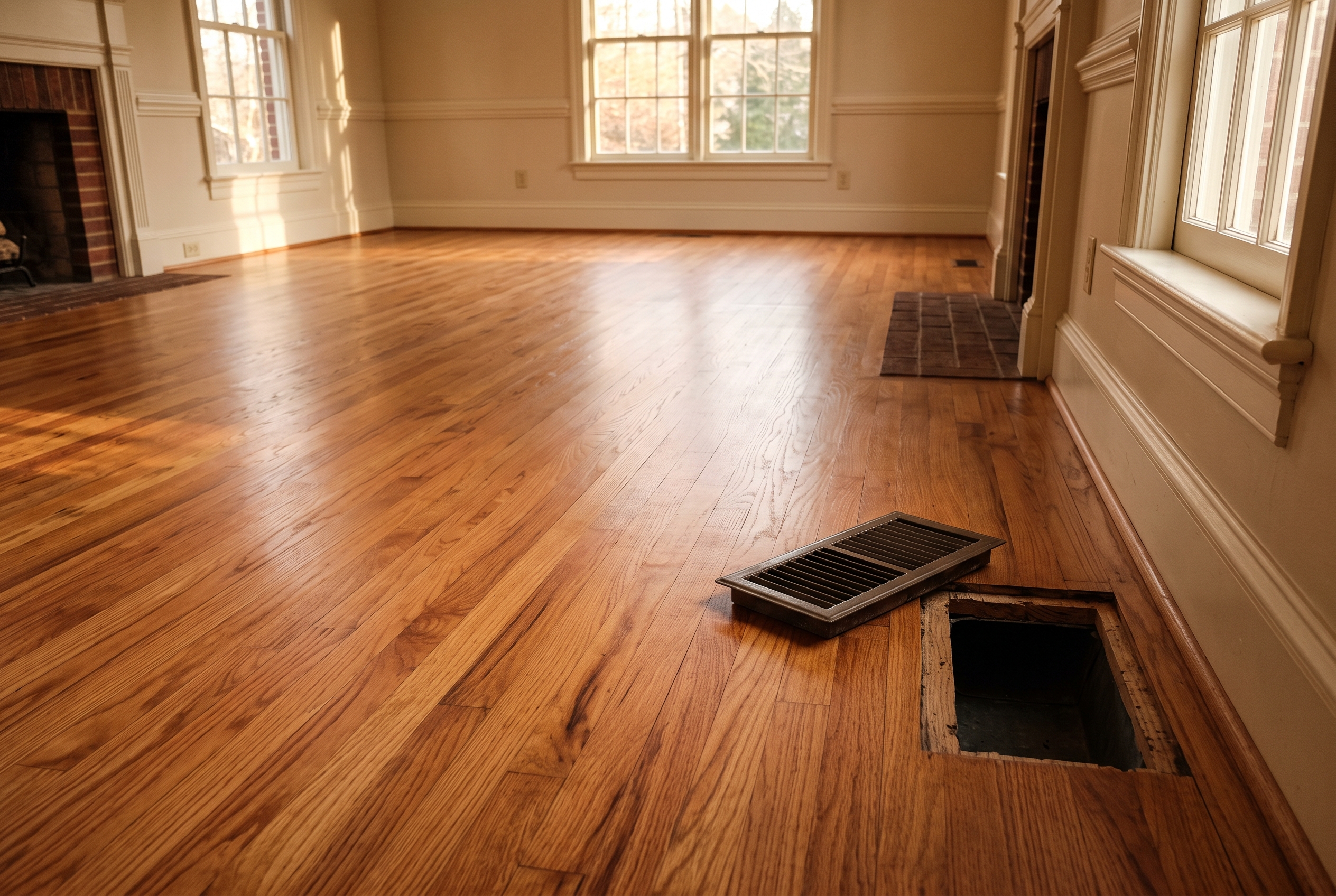
A solid hardwood floor can last a century or more, because it can be sanded down to fresh wood and refinished many times over its life. What wears out is the finish on top, which needs a fresh coat every few years in a busy kitchen or hall. An engineered floor lasts as long as its top layer of real wood can take another sanding, and for a good one that's still several decades.
| Floor | What wears first | How long it can last | What ends it |
|---|---|---|---|
| Solid hardwood | The finish, along traffic paths | 100 years or more | No wood left above the tongue |
| Engineered hardwood | The finish | 50 years or more | Wear layer sanded or worn through |
| The finish itself | Sheen and color in busy paths | A fresh coat every 3 to 5 years | Wear through to bare wood |
| Any floor left wet | The boards at the leak | Years, not decades | Rot, or cupping that won't flatten |
How Long a Solid Hardwood Floor Lasts
A solid hardwood floor lasts as long as there's wood left to sand, and for a floor that's looked after, that's a century or more. The National Association of Home Builders puts natural wood floors at 100 years or more in its study of how long the parts of a house last. That's the same company as slate and marble, and a long way ahead of carpet, which the study gives 8 to 10 years.
Sanding is what gives a solid floor its century. A solid board is the same wood all the way through. When the finish wears and the surface scratches, the floor can be sanded back to fresh wood and finished again, and each full sanding takes off about 1/32 to 1/16 inch. The National Wood Flooring Association (NWFA) says most solid floors can be sanded six to eight times over their service life. With recoats in between, those sandings stretch across several owners.
What finally ends a solid floor is running out of wood above the tongue, the ridge along each board's edge that locks into its neighbor. As sanding gets close to it, the thin top of the groove starts to splinter. The nails holding the boards begin to show between them, too. The NWFA stops recommending a sanding once less than about 3/32 inch of wear surface is left.
Thinner solid floors, such as 5/16-inch or 1/2-inch strip, have less wood above the tongue and fewer sandings in them. The same care buys them fewer decades. A standard 3/4-inch floor is the one with the century in it.
How Long Engineered Hardwood Lasts
An engineered floor can last 50 years or more, the figure the NAHB study gives for engineered wood. Where a particular floor lands depends on its wear layer, the top layer of real wood glued over a core of cross-layered plies. That's longer than the 20 to 40 years you'll often see online, and the wear layer explains the difference.
Wear layers run from about 1/16 inch to 1/4 inch. A thin one can't be sanded at all, so it lasts as long as its finish is kept up with recoats. A thick one can be sanded like a solid floor, just fewer times. The NWFA's refinishable program sets the line for a factory-finished board at a 2.5-millimeter wear layer, about 3/32 inch. For an unfinished board that's sanded and finished in place, the line is 3.2 millimeters.
| Wear layer | Full sandings, roughly | What that means |
|---|---|---|
| Under 2.5 mm | Usually none | Recoats keep it going |
| 2.5 to 3 mm | One, done carefully | One full refresh or color change |
| About 4 mm | One or two | Decades of refinishing |
| About 6 mm | Three or more | Close to a solid floor |
Those counts are rough, since each sanding takes 1/32 to 1/16 inch and a careful refinisher takes the least the floor allows. If you're buying engineered and want the option to refinish someday, choose a wear layer at or above that 2.5-millimeter line. For a floor you expect to keep for decades, about 4 millimeters gives you room for more than one sanding.
The spec sheet or the carton states the wear layer for a floor you're buying. On a floor that's already down, look at the edge of a board at a floor register or the top step, where the wear layer shows as a band of solid grain above the thin plies of the core.
The core itself rarely wears out. Water is what ends an engineered floor early, by soaking into the plies and lifting the layers apart. The habits that protect any wood floor protect this one twice over.
How Long the Finish Lasts Before It Needs Attention
The finish is the part of a wood floor that actually wears, and in a busy room it needs attention long before the wood does. The NWFA recommends a professional maintenance coat every 3 to 5 years. The existing finish is cleaned, lightly sanded and given a fresh coat, and the floor never goes down to bare wood. A guest bedroom may go much longer. The path from the back door to the kitchen sink may need it sooner.
A recoat is the step that keeps the sander away. Each time a worn finish is renewed before traffic wears through it, the wood underneath stays untouched, and the floor keeps its sandings for later. A recoat can't fix scratches that reach the wood, dents, gray patches where the finish is already gone, or boards that have cupped, and each of those takes a full sanding.
A finish is wearing thin when water stops beading on the busiest paths and darkens the wood instead. The paths start to look gray or dull next to the rest of the floor, and you may feel raised grain in spots. That's the time for a recoat, before the wear reaches the wood.
Prefinished floors come from the factory with a high-abrasion finish cured in the plant. It's tough enough that the first sanding of a factory-finished floor takes extra work. Sanding also cuts away the small beveled edges many prefinished boards have, so a refinished prefinished floor looks flatter than it did new.
Hand-scraped and wire-brushed floors are hard to sand evenly at all, so they're usually kept going with recoats. Penetrating oil finishes work another way again. They soak into the wood and get renewed with fresh oil, with no coat sitting on top.
How to Tell How Many Sandings Your Floor Has Left
Find a spot where you can see the edge of a board. The floor will show you whether it's solid or engineered and how much wood sits above the tongue, and that one look tells you most of what you need to know. Work through these checks:
- Lift a floor register out of its opening. The cut edge shows a board in cross-section, solid wood as one piece and engineered as a band of real wood over thin plies.
- Look at a threshold or the top of the stairs, where boards often end in the open, for a second look at the same layers.
- Measure the wood above the tongue with a thin steel ruler slipped into a gap between boards. Less than about 3/32 inch left means the floor has had its last full sanding.
- Look between the boards for nail heads. Bright nail heads in the gaps mean earlier sandings have taken the floor down close to the fasteners.
- Run your hand along the board edges. Splinters, or a sliver of exposed tongue, mean the top of the groove has worn too thin.
- Look for dips along the walls and around vents, the marks of earlier sandings done unevenly.
If the cross-section shows plenty of wood and the edges are tight and clean, the floor has sandings left, however tired the finish looks. When we see a floor in person, we can tell quickly whether there's enough wood left to sand.
What Wears a Hardwood Floor Out Early
Grit and water shorten a hardwood floor's life far more than age does. A floor that's kept clean and dry wears slowly and evenly. One that isn't wears through its finish in paths, and then the damage reaches the wood and uses up sandings the floor didn't need to lose.
Grit, Traffic and Furniture
Sand and grit tracked in on shoes act like sandpaper underfoot, which is why the path from the door goes dull first. A mat outside every exterior door and a breathable rug just inside catch most of it. A dust mop, or a vacuum on its bare-floor setting with the beater bar off, picks up the rest before it's ground in. Winter calls for more of it, with salt and sand coming in on every boot.
Furniture does its damage one spot at a time. Felt pads under every chair and table leg, wider protectors under heavy pieces, and lifting furniture when it moves keep the finish from being scraped through. Worn-down heel tips and pets' claws dent and scratch, so keeping nails trimmed matters as much as any cleaner.
Water, Pets and Leaks
Standing water is the fastest way to shorten a wood floor's life. Water that sits works into the seams and under the finish. It leaves gray or black stains and boards that cup, their edges rising above their centers. Pet urine does the same and adds a stain that can go deeper than a sanding reaches.
Wipe spills as soon as they happen, and keep plants on saucers raised on feet so water can't sit under them. Check the ice-maker line behind the refrigerator and the dishwasher's connections now and then. A slow leak can soak boards for weeks before anyone notices.
A floor that cups after a leak or a wet summer often flattens again as it dries, and it shouldn't be sanded until it has. Sanding a cupped floor flat while the boards are still wet underneath cuts off the raised edges. Once the wood finishes drying, the centers end up higher than the edges, a shape called crowning.
Moisture readings at the top and bottom of the boards tell when a cupped floor is ready to sand, more reliably than how it looks. Boards with deep black stains usually come out and get replaced.
Dry Winters and Humid Summers
Our heating season dries indoor air enough to open gaps between boards, and humid summers swell them shut again. Thin gaps that open in winter and close by summer are normal and don't shorten a floor's life. Big, repeated swings do, and so does moisture from underneath, because a damp crawlspace or basement can keep the bottom of the boards wetter than the top until the floor cups year after year.
Wood floors do best held between 30 and 50 percent relative humidity at 60 to 80 degrees, the range the NWFA gives. A small hygrometer tells you where your house sits. A humidifier, whole-house or room-sized, brings winter air back into range through the heating months, and air conditioning or a dehumidifier handles summer. A crawlspace with a vapor barrier over the soil keeps the underside of the floor dry.
Cleaners That Strip the Finish
The wrong cleaner can dull a finish in months. Bruce rules out ammonia and wax-based cleaners, detergents, bleach, polishes, oil soaps and vinegar for its hardwood, and asks that its floors not be mopped with water. Steam mops are out for the same reason, since heat and moisture work into the seams.
Products that promise to restore shine leave a film that builds up and has to come off before the floor can take a recoat. Use a cleaner made for finished wood on a microfiber mop that's barely damp. For a prefinished floor, follow the care sheet that came with it.
Too Much Sanding, or the Wrong Kind
A floor can lose more wood to one careless sanding than to years of traffic. An aggressive first pass, a sander that lingers in one spot, or a full refinish every few years when a recoat would have done all use up wood for nothing. A gouge left by a drum sander also means a heavier pass the next time.
The habit that saves the most floor life is simple. Recoat when the finish is only dull, and sand only when scratches reach the wood, the floor has dents or gray patches, or you want a new color. A careful sanding takes the floor down a little at a time with progressively finer paper, and it takes no more wood than the scratches require.
When a Hardwood Floor Is Truly Worn Out
The signs that a hardwood floor is truly finished are few: no wood left above the tongue, boards that have rotted or split from underneath, or years of moisture that have cupped it beyond flattening. Almost everything else that makes a floor look finished can be sanded out, refinished or repaired.
| Looks like the end | What it usually is |
|---|---|
| Gray, worn traffic paths | A worn finish that sands out |
| Deep scratches and dents | A full sanding, not a new floor |
| Dark water or pet stains | Sands out if light; new boards if black |
| A dated orange or dark color | A refinish with a new stain |
| Gaps between boards in winter | Normal seasonal movement |
| Squeaks and loose boards | Fastening or subfloor repair |
| Splinters along edges, nails showing | Worn to the tongue: time to replace |
| Soft or spongy boards | Water damage underneath: replace and repair |
When a few boards are ruined, the rest of the floor doesn't have to go. Damaged boards can be cut out and new ones woven in, matched by species and width. Once the whole floor is sanded and finished together, the repair disappears.
If the floor still has wood left and you're weighing a refinish against a new floor, start with the cost gap. On national figures, a refinish runs a fraction of what new hardwood costs installed, and it keeps a floor that already fits the house.
Is the Oak Floor Under Your Carpet Still Good?
Usually it is, as long as no pet stains or leaks have soaked through. In many Alexandria and Arlington houses built from the 1930s into the 1960s, carpet went down over solid oak strip flooring, and decades under carpet are kind to wood. Nobody walked on the finish, and the floor may have been sanded once or never, so it still has nearly all of its sandings.
Expect a few things when the carpet comes up: a row of tack-strip holes along the walls, staples from the pad, and sometimes a dark ring where an old pad stuck to the finish. The holes get filled during a refinish. A patch of different wood where a wall was moved or a register relocated is common in remodeled houses, and new boards can be woven in so it blends.
To check before you pull up a whole room, lift a corner of the carpet in a closet with pliers, or look at the floor through a heating register. Oak with tight joints and no black staining is very likely worth refinishing. Pet stains are the one surprise to look for, since urine can soak through carpet and pad into the wood without anyone seeing it.
Old Town's oldest houses are a different case. Original floors in Old Town may be heart pine or other old-growth wood with a long history of hand sanding, and they call for a gentler approach than a mid-century oak floor.
How to Make a Hardwood Floor Last Longer
Making a hardwood floor last longer comes from small habits more than big projects. Keep grit off it, keep water off it, keep the air steady, and renew the finish before it wears through. These are the habits that let the sander come out once every few decades instead of every few years:
- Put a mat outside every exterior door and a breathable rug inside it, skipping rugs with rubber or vinyl backs that trap moisture against the finish.
- Dust-mop or vacuum on the bare-floor setting often enough that grit never builds up, and more often in winter.
- Clean with a cleaner made for finished wood on a barely damp microfiber mop, and never steam-clean or wet-mop.
- Keep felt pads under every leg and replace them when they wear through or pick up grit.
- Trim pets' nails and wipe up accidents right away.
- Hold indoor humidity between 30 and 50 percent, with a humidifier through the heating months.
- Close blinds against strong afternoon sun or use UV-filtering window film, and move rugs now and then so the wood under them ages with the rest.
- Have busy rooms recoated every few years, before the finish wears through to the wood.
What a Recoat, a Refinish and a New Floor Cost
Nationally, a screen and recoat runs about $1 to $2.50 a square foot, in HomeAdvisor's cost figures. A full sand and refinish runs about $3 to $8, and new hardwood installed about $6 to $25. Taking up an old wood floor adds about $2 to $4 a square foot to a replacement.
| 400-square-foot living and dining area | Per square foot | For 400 square feet |
|---|---|---|
| Screen and recoat | $1 to $2.50 | $400 to $1,000 |
| Sand and refinish | $3 to $8 | $1,200 to $3,200 |
| New hardwood, installed | $6 to $25 | $2,400 to $10,000 |
| Removing the old floor | $2 to $4 | $800 to $1,600 |
Several things move a refinishing price. A stain color adds about $1 to $3 a square foot over a clear finish. Stairs run about $4.50 to $8 a square foot, because each tread is sanded largely by hand. Replacing a damaged board runs about $6 to $12 a square foot, and dust-containment equipment adds around $2.
A small room costs more per square foot than a large one, since the setup is the same either way. Taking up old carpet to reach the oak adds roughly $120 to $720, plus a haul-away fee.
The arithmetic favors keeping a floor that still has wood in it. On those national figures, a refinish costs a fraction of a new floor, and a recoat a fraction of a refinish. We quote the real scope after we see the floor, and for a larger project you can spread the cost over time.
Refinishing and Repairing Hardwood With Rick's
At Rick's Flooring, we sand and refinish hardwood floors across Alexandria and Northern Virginia, from a single tired room or a staircase to every wood floor in the house. We're a family-owned company, and we've done this work in the area for decades.
Before any sanding, we walk the floor and fix loose boards, popped nails and squeaks. We sand to fresh wood with progressively finer grits and keep the dust contained. We can also test a few stains on your own boards, so you choose a color from the real thing. Damaged boards come out and new ones are woven in, matched by species, before the whole floor is finished as one.
When a floor is past saving, the replacement comes from our catalog, including solid hardwood from Bruce, Hallmark Floors and Somerset, and engineered lines from Mannington and Mohawk for floors over concrete or below grade. A free in-home estimate brings one of our project specialists to look at your floor, tell you what it needs and give you a plan and a price.
You're also welcome at our showroom on Richmond Highway, and our crews refinish floors in Arlington, Springfield and across Northern Virginia, Maryland and Washington, D.C.
Questions About How Long Hardwood Lasts
Does a Hardwood Floor's Warranty Tell You How Long It Will Last?
No. The long warranties on prefinished floors cover the factory finish against wearing through under normal household use, and some run for decades. They describe the finish, though, and the wood can outlast them. A floor routinely outlives its finish warranty, because the wood can be sanded and finished again after the factory coat is gone.
The booklet that comes with the floor is what any claim is judged by, so keep it with your spare boards and the receipt.
Does Hardwood Outlast Laminate?
Yes, by a wide margin. The NAHB study puts laminate at 15 to 25 years and natural wood floors at 100 years or more. The difference is that laminate is replaced when its wear layer goes, while a wood floor is sanded and refinished.
For a house you plan to stay in, that gap is the strongest case for wood in the rooms that matter most. Laminate still earns its place where water and heavy wear would shorten any floor's life.
How Long After Refinishing Can You Walk on the Floor?
It depends on the finish, since water-based finishes dry and cure faster than oil-based ones. Rugs go back last, because a rug laid on a finish that hasn't fully cured can mark it. We give you a realistic timeline for your floor before the job starts, so you can plan around the days the rooms are off limits.
While the finish cures, walk on it in socks only when the timeline allows and keep pets off it. Put felt pads on the furniture legs first, then lift each piece back into place.
Do Harder Wood Species Last Longer?
No, harder species don't last longer in the way that counts, though they do dent less. Hickory and hard maple resist dents from dropped pans and heels better than softer woods, and that keeps a floor looking better between refinishes.
Every species gives up about the same 1/32 inch or so to each sanding. A hard floor and a soft one of the same thickness carry about the same number of refinishes, so hardness changes how the floor looks along the way rather than how many decades it has.
Finding Out What Your Floor Has Left
If you've lifted a register and still aren't sure what you're looking at, schedule an estimate visit, and one of our project specialists will look at the floor, tell you how much wood it has left, and lay out whether it needs a refinish, a repair or a new floor.


