

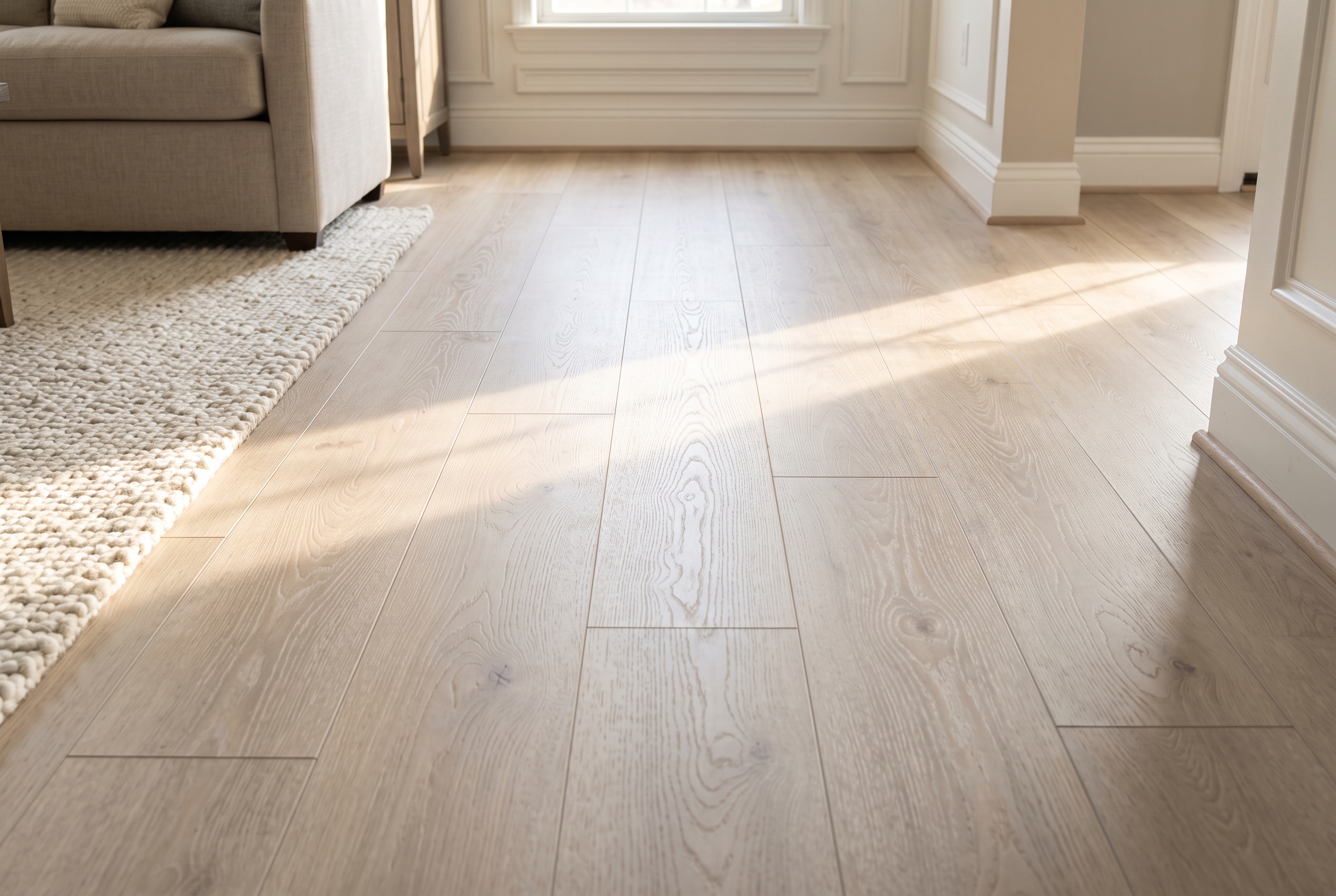
The laminate that passes for real wood has texture you can feel following the printed grain and enough different plank designs that you never catch the same board twice in a room. It has a low-sheen surface, and its joints are laid the way a hardwood installer would lay them. Get those right and visitors standing in the room will take it for wood. On your hands and knees, or right beside a real oak floor, it's still laminate, and the closer anyone looks, the more the plank itself has to carry.
| Feature | Looks like wood when | Gives it away when | Check on a sample |
|---|---|---|---|
| Texture | Ridges follow the printed grain and knots | One texture is stamped over everything | Run a fingertip across a knot |
| Plank designs | No twin shows up nearby | The same knot repeats every few rows | Lay out eight or ten planks |
| Sheen | Low gloss or matte | Window glare shows a flat picture | Look across it toward a window |
| Edges | The bevel suits the look and the color | Square edges, or pale bevel stripes | Look straight down at a joint |
| Plank size | Long planks in mixed lengths | Short planks in one length | Read the plank size on the carton |
| Layout | End joints scattered at random | Ladders, H shapes, slivers at walls | Look at a finished room photo |
What Makes a Laminate Plank Look Like Real Wood
A laminate plank is a photograph of wood. The North American Laminate Flooring Association (NALFA) describes the build as a clear wear layer over a decorative layer of high-definition imagery. Under that sits a core of wood fibers pressed together under heat and pressure, with a backing on the bottom.
Every feature that makes one plank look more real than another hides the fact that the wood is a picture. It shows in what is printed, what is pressed into the surface, how the edges are cut, how much the surface shines and how big the planks are. Every brand says its floor looks real. These are the features you can see and feel for yourself on a sample in your hand, whatever label is on the carton.
What Embossed in Register Means
Embossed in register, usually shortened to EIR, means the texture pressed into the top of the plank lines up with the printed grain underneath. The knot you see is the knot you feel, and the grain lines rise where they are drawn. Plain embossed laminate has texture too, but it is one pattern stamped across the whole surface. Your fingers find ridges running straight through a knot, and that mismatch is what makes a hand say plastic even when the eye said oak.
For a floor meant to pass as wood, EIR is worth paying for. It changes how a plank reads up close, in low morning sun and underfoot in socks, and it costs only a little more than plain embossing. A clean, contemporary look built on a smooth matte print is the exception, since sheen and plank size count for more there. Texture also hides the fine scratches a dog leaves far better than a smooth face.
RevWood collections such as Castlebriar, Elderwood and Antique Craft, and Restoration Collection styles such as Heirloom and Sawmill Hickory, are embossed in register, and they sit together under the embossed-in-register texture in our catalog. To check any sample, run a fingertip across a knot and then along a cathedral, the arched grain in the middle of a flat-sawn board. On an EIR plank you'll feel both shapes. On plain embossing you'll feel the same ridges everywhere.
Print Quality and How Often Planks Repeat
Every laminate line prints its planks from a fixed set of images. The fewer images there are, the sooner a distinctive knot or streak turns up again in the same room. On a bedroom floor you may never notice. Across an open kitchen and family room, with a dozen rows in view at once, a repeat is the first thing a sharp-eyed guest spots, and once you've seen it you can't stop seeing it.
Some lines put a number on it. Mannington says select styles in its Restoration Collection print up to 20 different plank designs, with no design repeated inside a carton. When a line doesn't say, find out for yourself: lay eight or ten planks from two cartons side by side and look for twins.
That same spread of planks shows print quality. Look closely at the edges of the knots and the fine grain lines. A sharp print keeps them crisp at arm's length, and a soft one turns them into a smudge of color. Even a line with plenty of designs can land two identical planks side by side if the floor goes down one carton at a time, which is a layout problem with a simple fix.
Why Low-Gloss Laminate Reads as Wood
A low-gloss or matte surface reads as wood because that is what most wood floors wear today. Satin and matte finishes soften light. A shiny laminate throws glare off the whole surface at once, and in that glare the eye sees a flat picture under a coating.
High gloss is a style of its own and can look striking in a formal room, but it reads as a polished coating, never as wood that has been lived on.
To check a sample, hold it flat at counter height and look across it toward a window. A convincing plank shows you the grain through a soft sheen. An unconvincing one shows you the window. Choosing from low-gloss laminate at the start puts you among planks that already pass that test.
Bevels and Edge Profiles
Bevels are small angled edges along the top of a plank, and they put a fine shadow line between boards the way real planks have. Square-edged laminate meets with no line at all, so from across a room it can read as one continuous printed sheet.
The right bevel depends on the look. A micro bevel, barely there, suits a clean contemporary floor. A deeper or painted bevel, with the edge colored to match the face, suits rustic, hand-scraped and reclaimed looks, the way old boards show worn, softened edges.
Watch for a bevel that doesn't match the face. If the chamfer is lighter or shinier than the plank, every joint shows as a pale stripe, so look straight down at a joint on the sample. The bevel should read as a shadow in the plank's own color. Deeper bevels also hold grit, and a floor with them needs a vacuum with a hard-floor head as well as a broom.
Plank Width, Length and Random Sizes
Longer and wider planks look more like wood because they show more of each board and put fewer end joints on the floor. Short planks multiply the joints, and a line that comes in one length tends to line those joints up into a ladder. Real floors, cut from boards of every length, rarely have one. Lines sold in random lengths or mixed widths break up that rhythm on their own.
Big planks ask more of the floor underneath. A long plank bridges dips that a short one would follow, so the subfloor has to be flatter to keep the joints from flexing. The carton and the product page list each plank's length and width. Read them before you fall for a sample, because a 4-foot plank and a 6-foot plank in the same color make two different-looking floors.
Color Variation, Knots and Character
Real boards differ from one to the next in color, grain and the knots and mineral streaks they carry. A laminate with visible variation looks like a floor cut from many trees, while one with every plank the same looks printed. Character marks such as knots, small checks and a darker heartwood streak help as well, as long as they don't repeat close together.
High variation is also forgiving of repeats, since the eye expects every board to differ. It can be too much in a small room, though, where strong contrast between boards competes with the rug and the furniture. A single sample can't show how variation reads across a floor, so look at several planks of the style together, or at a photo of a finished room, before you decide.
Does Laminate Sound and Feel Like Hardwood?
No, not quite, though a good laminate floor comes close. Laminate floats on a thin pad over the subfloor, while hardwood is nailed or glued down. That small cushion of foam and air under a hard plank can make footsteps sound hollow and hard shoes click, where nailed hardwood gives a duller, more solid sound.
The sound that gives laminate away most is the drum, a hollow note under each step. It gets worse wherever the subfloor dips, because each dip leaves a pocket of air under the plank, so a floor flattened before the planks go down sounds noticeably more solid than the same planks laid over humps and hollows. Heels and pet nails add a click on any hard floor, and a big open room with little in it adds an echo.
The fix for a hollow sound is rarely a thicker pad. A laminate floor wants one thin pad of the type its instructions name, and a soft or doubled pad lets the joints flex, which sounds worse and can break the locks over time. Many of the most realistic lines come with the pad attached to the back of every plank, so there's nothing to choose and nothing to double up.
Plank thickness changes how solid a floor sounds and feels. It doesn't change how real the floor looks, and the AC rating measures how the surface wears, not how convincing it is. Rugs, upholstered furniture and curtains take care of most of the echo, the same way they would in a room with real wood, and felt pads under chair legs quiet the scrape.
Underfoot, laminate feels a little warmer and a little firmer than wood at the same time. It's warmer because the pad separates it from a cold subfloor, and firmer because a laminate plank has no give. In socks you'll notice little difference, and soft-soled slippers close the rest of the gap.
How to Test a Laminate Sample Before You Buy
Judge a sample where it will live, under your light. Order two or three, since every style in our laminate catalog has an Order Sample button, and give each one these tests over a day or two:
- Set it on the floor of the room it's for and look down at it standing up. That's the distance your floor is usually seen from, and a good plank reads as wood from there.
- Kneel and look at it at arm's length. Knots and grain lines should stay crisp, where a soft print blurs into color.
- Put it near a window and look across it at a low angle. Low, raking light shows texture, and on an EIR plank the light catches the grain right where it's printed.
- Run your hand along the grain and across a knot. Your fingers should find the shapes your eyes found.
- Look again at night under your own lamps. Warm bulbs push a plank toward yellow, and a gray-beige plank that looked right at noon can turn flat or greenish in the evening.
- Hold it against your cabinets, trim, stair treads or a neighboring floor. Wood tones fight when their undertones clash, such as a pinkish red oak beside yellow pine trim.
- Look at several planks of the style before you order. One sample can't show repeats or how the variation reads across a floor.
For the whole-floor view, the See in my room button on each style drops it into a photo of your own room. It shows tone and plank size well. It can't show texture or sheen, so use it to narrow the field and let the samples make the call.
Installation Details That Make Laminate Look Real or Fake
A good plank laid badly still looks like laminate. The tells are almost all layout: end joints lined up into ladders or H shapes, the same plank twice side by side, thin slivers along a wall, moldings in a color that matches nothing, and a cut edge stopping short at a door casing. Nearly all of them are prevented before the first plank clicks in.
Real floors have their end joints scattered at random. A laminate floor gets there by keeping the end joints in each row at least 8 inches from the joints in the row beside it, and by changing that offset from row to row so no pattern forms. H-joints, where end joints line up every other row, and stair-step runs are the two patterns the eye catches first.
Twins side by side happen when planks go down one carton at a time. The habit that prevents it is to open three or four cartons, pull from each in turn, and set aside any plank that matches its neighbor too closely. Pulling from several cartons also spreads out small color differences between them.
Slivers at the walls come from starting the first row against one wall without measuring to the other. With the room measured first, a last row that would come out narrower than half a plank means the first row gets cut down, so both walls end with a decent width. Short end pieces need the same care, since a run of tiny offcuts at the ends of rows looks like patchwork.
Direction matters more than you might expect. Planks laid parallel to the longest wall, and where possible running toward the main window, let the light travel along the grain and hide the seams. Planks laid across the light show every joint as a thin ridge of shadow.
Moldings are where a convincing floor most often gets let down. A T-molding, reducer or quarter round in a flat brown announces that the floor is something else. The moldings made for a line come wrapped in the same decor as the planks, and the planks laid beside each molding can be picked for the closest blend.
At the walls, every floating floor needs a gap so it can move, and that gap hides under the baseboard, or under quarter round where the baseboards stay. At doorways the casings are undercut so the floor slides beneath them instead of stopping at a cut edge.
Moldings can be swapped later, but a ladder of joints or a pair of twins in the middle of the room can't be fixed short of taking rows apart, so the layout is worth getting right the first time.
Laminate on Stairs and Stair Noses
Stairs are where laminate most often gives itself away. The front edge of each step needs a nose piece, and the nose is a molding with its own profile and color, so a nose in a near-match brown makes every step read as plastic. The stair nose made for the line, wrapped in the same decor, keeps the color and grain continuous. It usually comes in a flush style that sits level with the tread and an overlap style that caps it.
Two things help beyond the right piece. The grain on the nose should run the same direction as the tread, and every nose has to be fastened firmly, because a stair edge takes more force than any spot on a flat floor.
Where the stairs are original oak in good shape, keeping them wood often looks better than covering them, and the laminate meets them at a clean transition at the bottom step. Sanding and refinishing a staircase is part of our hardwood refinishing work, so the stairs can be brought back to a color that suits the new floor.
Which Wood Looks Are Most Convincing in Laminate
Oak is the easiest look for laminate to carry. Its grain is open and easy to read, its variation is moderate, and it prints and embosses well, so an oak-look plank holds up at closer range than most. High-variation looks such as hickory and rustic, hand-scraped styles are forgiving in a different way, because the eye expects every board to differ. The hardest looks to fake are smooth, uniform, deeply figured woods like walnut, where depth is the whole point.
White and Red Oak Looks
White oak looks are among the most convincing laminate visuals. White oak's grain runs fairly straight and its color is soft, so a well-printed plank has little to get wrong. Red oak's pinker tone and bold cathedral grain print well too. Those big arched figures are memorable, though, so a red oak look shows a repeat sooner and wants a line with plenty of plank designs.
Oak looks run through RevWood collections such as Castlebriar, Elderwood, Antique Craft and Western Row, and through the Restoration Collection's Historic Oak. To check an oak sample, find the cathedral in the middle of a plank and look for it on the next few planks. If the same arch turns up in the same place, the line has fewer designs than you want for a big room.
Hickory, Rustic and Hand-Scraped Looks
Hickory is one of the most forgiving looks for laminate. Real hickory swings from cream to dark brown within a single board, so nobody expects two planks to match and a repeat hides in the variety. Rustic looks with knots, saw marks and weathering work the same way.
Hand-scraped and wire-brushed effects are where texture matters most. A scraped look with flat texture reads as a photograph of a scraped floor, while the same look embossed in register has its dips and ridges where the eye expects them. The Restoration Collection's Hillside Hickory and Sawmill Hickory carry that kind of variation, and RevWood's Rare Vintage collection brings a rustic chestnut look.
Check a rustic sample in raking light. The scrapes and brushed grain should catch the light where they are printed. If the light shows smooth plastic over a picture of texture, the look won't hold up close.
Walnut and Smooth, Formal Looks
Walnut and other smooth, uniform, richly figured looks are the hardest for laminate to carry, because what makes real walnut beautiful is depth. Light seems to go into the wood and come back out, and a printed image under a clear layer flattens that.
These looks still work well in rooms seen mostly from standing height. With a low-sheen surface, long planks and low variation, the floor reads as a calm, dark field, and Karastan's Danbury Alcove is one of the walnut looks we carry. When a walnut floor is the whole point of a room that will be seen up close, such as a formal dining room or a study you sit in for hours, real walnut is the better fit for that room, and laminate can still carry the busier rooms around it.
Can Laminate Sit Next to a Real Hardwood Floor?
Yes, as long as the two floors meet at a clean break and the laminate complements the wood without trying to copy it. An exact match rarely lasts, because the oak ambers with age, gets refinished to a new color, or catches the morning light at the same moment as the laminate and shows which one is wood. A deliberate difference looks intended, and a near-miss looks like a mistake.
In Alexandria and Arlington, many center-hall colonials and split-levels still have their original oak on the stairs and the second floor while the main level gets a new floor. The meeting point is usually the bottom of the stairs or a doorway off the front hall.
Put the transition at a door or threshold, where a change of floor reads naturally. Choose a laminate a shade or two lighter or darker than the oak, or a different species look altogether. Match the undertone, warm with warm and cool with cool, even when the color differs.
The two floors will also age on different paths. Laminate can't be refinished the way the oak can, since sanding would cut through its printed layer. If the oak is due for a refinish in the next few years, choose the laminate for the color the oak is heading toward, or refinish the oak first and pick the laminate against its new color.
What Realistic Laminate Costs
Nationally, laminate runs about $3 to $13 a square foot installed, in HomeAdvisor's cost figures. Material alone runs about $1 to $6.50 a square foot, and the planks with the most realistic detail sit at the upper end of that range.
The texture tiers show where realism adds cost. Smooth planks run about $1.50 to $2.50 a square foot, embossed-in-register planks about $2 to $4, and hand-scraped looks about $3 to $6. Labor adds about $2 to $8 a square foot.
| For a 300-square-foot room | Per square foot | For the room |
|---|---|---|
| Smooth print, material | $1.50 to $2.50 | $450 to $750 |
| Embossed in register, material | $2 to $4 | $600 to $1,200 |
| Hand-scraped look, material | $3 to $6 | $900 to $1,800 |
| Labor, any plank | $2 to $8 | $600 to $2,400 |
| Installed, all in | $3 to $13 | $900 to $3,900 |
Going from a smooth print to an EIR plank comes to a few hundred dollars on a room that size, small next to labor and prep. Longer planks, a pad attached to every plank and a waterproof core also push a line up the range. A plank without an attached pad needs a separate one, at roughly $30 to $60 per 100 square feet.
Plan on 5 to 10 percent more material than the room measures, for cuts and for a few spare planks to keep for repairs. The work around the plank moves a quote too. Taking up an old floor runs about $400 to $600 for a 200-square-foot room, and flattening the subfloor, stairs fitted one step at a time and the moldings at every doorway all add to it.
We price your rooms once we've seen them, because the floor underneath and the stairs move the number more than the plank you pick.
Our Laminate Lines With the Most Realistic Detail
At Rick's Flooring, we carry laminate from Mohawk, including its RevWood line, along with Mannington's Restoration Collection, Karastan BelleLuxe Waterproof, Bruce, Tarkett Home and TRUCOR. RevWood and the Restoration Collection are where you'll find embossed-in-register texture and the deepest sets of plank designs. Every style can be sampled and tried in a photo of your room before anything is ordered.
Our installation crews put down the laminate we sell, along with the underlayment and any subfloor repair the floor needs, and a project manager coordinates the job. A free in-home estimate brings one of our project specialists to your home to measure the rooms and price the floor you have in mind.
From our Richmond Highway showroom in Alexandria, we work in homes across Alexandria, Arlington, Springfield and Northern Virginia, as well as Maryland and Washington, D.C.
Questions About Realistic Laminate
Does Realistic Laminate Fade in the Sun?
No, not the way real wood does. A laminate floor's wood look is a printed image sealed under a clear wear layer, so the sun doesn't darken or amber it the way it changes real oak, and light resistance is one of the categories NALFA tests for its laminate certification.
What does change in a sunny room is everything around the floor. Wood trim deepens, and a rug or a sofa leaves the floor under it looking a little different from the floor in the open. Blinds or UV-filtering window film protect the whole room, the floor included.
Is Waterproof Laminate as Realistic as Standard Laminate?
Yes. Waterproof laminate gets its water protection from the core, the joints and the edges, while the realism features (the print, the EIR texture, the bevel and the sheen) are separate choices. The same look can come with water protection or without it, so you don't trade realism for a kitchen-ready floor.
A waterproof rating tells you how a floor holds up against standing water in a kitchen or an entry. It changes nothing about how real the plank looks.
Is Textured Laminate Harder to Clean?
Yes, a little. Grit settles into the texture and the bevels, so a textured floor needs a vacuum with a hard-floor head as well as a broom, and never a beater bar. Past that, the routine is the same as for any laminate: a barely damp mop, and no wax, polish or soap.
Steam is the one place the brands differ. Mannington approves residential steam mops on its Restoration Collection, while Mohawk says no steam on its laminate unless the floor carries its steam-mop warranty, so follow the care page for the line you own.
Can One Damaged Plank Be Replaced?
Yes. A click-together floor can be taken apart back to a damaged plank and put together again, and a single plank can also be cut out and replaced where it lies. Either way, a plank from your own order matches best.
Keep a few leftover planks wrapped in their carton in a dry closet. Planks from a later run may not match your floor, so the spares from your own order are the ones that will disappear into it.
Choosing a Plank That Passes in Your House
Start with two or three samples and run the tests in your own rooms, in daylight and at night, against your trim and your cabinets. When one passes all of them, schedule your estimate visit and one of our project specialists will measure the rooms and price the floor with the plank you picked.


